
 is pushing more collectors to crack slabs than ever.)
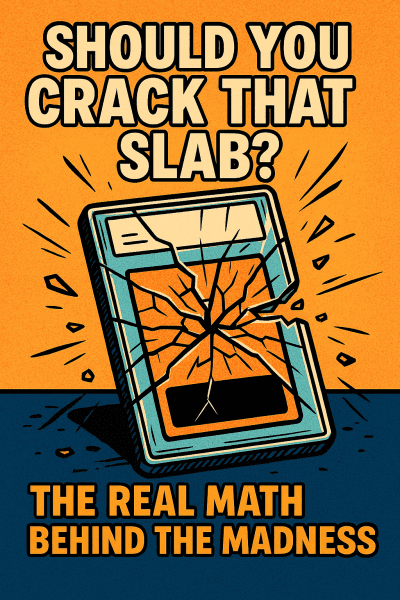
Cracking a slab is one of those hobby moves that looks bold on Instagram but feels a lot less glamorous when you’re staring at a $200 card and a pair of pliers. Every collector has thought about it. Some have done it. A few have bragged about it. Most won’t admit the disasters.
The truth? Cracking a slab is a calculated gamble, and the people who win are the ones who treat it like math—not emotion.
🧠 When Cracking Actually Makes Sense
There are only a few scenarios where cracking is a strategic move instead of a panic move.
- You’re crossing to a company with higher resale upside.
Think CGC → Beckett Black Label chase, or PSA 9 → CGC 9.5 for One Piece. If the upside is real and the card is clean, it’s worth considering. - The subgrades tell a story.
A 9.5 with a single 9 subgrade is a different animal than a “true 9.5.” If you know the weak spot is fixable (surface debris, fingerprint, light dust), cracking can be a value play. - The slab is scratched, scuffed, or ugly.
A clean reholder won’t fix a bad grade. But a crack-and-regrade might—if the card itself is strong. - You’re correcting an obvious misgrade.
It happens. Humans grade cards. If the card is clearly better than the label, cracking is sometimes the only path to justice.
💀 When Cracking Is a Straight-Up Disaster
Most cracking fails fall into the same traps:
- You’re chasing a miracle bump.
“Maybe this PSA 8 is actually a 10.”
No. It’s not. And now it’s raw. - You didn’t inspect the card under proper lighting.
Slabs hide sins. Once it’s out, you see the truth—and sometimes it’s ugly. - You’re crossing companies without understanding their standards.
A CGC 9 doesn’t magically become a PSA 10. A Beckett 9.5 doesn’t always cross to a PSA 10. Hobby myths cost people money. - You cracked out of frustration, not strategy.
Emotional cracking is the hobby equivalent of drunk texting. It never ends well.
📉 The Real Risk: Raw Value vs. Slab Value
Once you crack, the card becomes raw until it’s safely in another slab.
Raw value is almost always lower than slab value—even if the slab grade was mediocre.
If the card gets damaged during cracking?
Game over. No appeal. No insurance. No “my bad.”
This is why the best collectors treat cracking like an investment decision, not a hobby impulse.
📈 The Smart Way to Decide
Before you crack anything, ask three questions:
- What’s the upside if everything goes perfectly?
- What’s the downside if the card stays raw or grades lower?
- Do I trust my eye more than the grader’s?
If the answer to #3 is “maybe,” the answer is “no.”
🏚️ The Grading Landscape Is a Mess (And Cracking Slabs Exposes It)
You can’t talk about cracking slabs in 2026 without talking about the grading landscape itself—because the landscape is the reason so many collectors even consider cracking in the first place.
The hobby isn’t dealing with three independent grading companies anymore. It’s dealing with one corporate machine wearing three different masks.
Collectors—the parent company of PSA—now owns PSA, SGC, and Beckett.
That’s not competition. That’s consolidation.
And consolidation always leads to the same thing: higher prices, slower service, and less accountability.
- PSA raises prices because they can.
- SGC slows down because they’re no longer trying to compete.
- Beckett loses its identity the moment Collectors takes the wheel.
This isn’t a coincidence. It’s what happens when one company controls the majority of the grading market and has no real incentive to improve anything for collectors.
Meanwhile, CGC is the only major grader left outside the Collectors umbrella—and even they’ve slowed down because the entire market is reacting to the same bottleneck: Collectors grabbing everything in sight without thinking about the long-term impact.
The result is a grading ecosystem where quality drops, turnaround times stretch, and prices climb, all while Collectors tells everyone it’s “good for the hobby.”
Collectors don’t trust the grades.
They don’t trust the consistency.
They don’t trust the motives.
So what happens?
People start cracking slabs—not because they want to, but because they feel like they have to.
Cracking slabs isn’t just a hobby move anymore.
It’s a symptom of a broken system.
🏁 Final Take
Cracking slabs isn’t reckless—it’s high-risk strategy.
The collectors who win treat it like a business decision.
The collectors who lose treat it like a lottery ticket.