
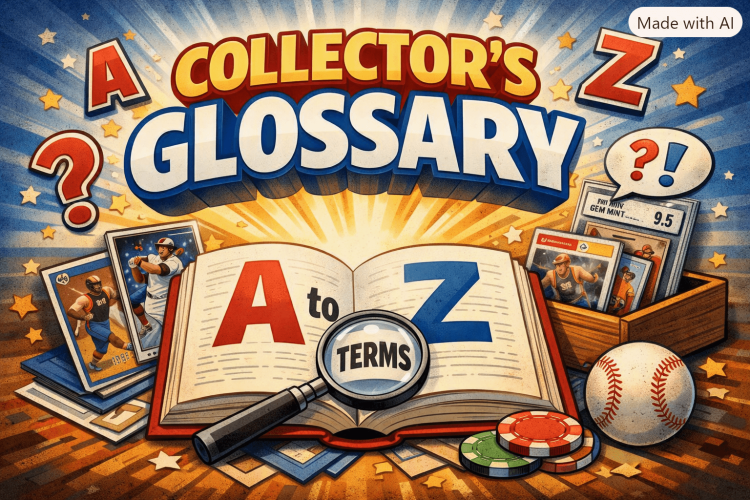
If you’re new to the hobby, baseball card terminology can feel like you’re trying to read hieroglyphics. The good news? Once you learn the basics, everything suddenly clicks. This glossary breaks down the terms every collector needs to know — without the fluff, confusion, or gatekeeping.
Base Card
The standard card in a set. No special numbering, no autograph, no relic. Just the player’s regular card.
Parallel
A version of the base card with a different color, pattern, or finish. Usually rarer. Think “Gold /50,” “Blue /150,” “Rainbow Foil,” etc.
Insert
A card that isn’t part of the base set. Often themed — milestones, rookies, legends, weird Ginter stuff, you name it.
Short Print (SP)
A card printed in lower quantities than the base. Usually photo variations or special versions.
Super Short Print (SSP)
Even rarer than SPs. These are the cards people chase because they’re legitimately hard to pull.
Case Hit
A card so rare you typically get only one per sealed case of product.
Serial Numbered
Cards stamped with a print run: “/99,” “/25,” “1/1,” etc. Smaller number = more desirable.
Autograph (Auto)
A card signed by the player. On‑card autos are preferred over sticker autos.
Relic
A card containing a piece of jersey, bat, patch, or other memorabilia. Game‑used relics > player‑worn.
Rookie Card (RC)
The player’s first flagship card. The RC logo matters. Prospect cards are NOT rookie cards.
Prospect Card
Pre‑rookie cards, usually in Bowman. High upside, high risk.
Slab
A graded card sealed in a plastic case by PSA, SGC, CSG, TAG, etc.
Pop Report
A grading company’s count of how many copies exist at each grade.
Raw
Ungraded card.
Comps
Comparable recent sales used to determine value.
Break
A group opening of boxes where participants buy teams or spots.
Wax
Sealed product — boxes, packs, cases.
PC (Personal Collection)
Cards you keep because you love them, not because you plan to sell.