

Welcome from Ken
Hey everyone — Ken here from Ken’s Cool Cards! Whether you’re a grizzled vintage collector or just pulled your first chrome refractor, understanding grading is one of the most valuable skills you can develop in this hobby. SGC has been a personal favorite of mine for years, especially for vintage. This guide is the resource I wish I’d had when I first started submitting cards. Let’s dig in!
1. Introduction: What Is SGC?
If you’ve spent any time in the sports card hobby, you’ve seen those sharp black-bordered slabs with the distinctive label. That’s SGC — and it’s one of the most respected names in card authentication and grading in the world.
A Brief History of SGC
Sportscard Guaranty Corporation — universally known as SGC — was founded in July 1998, right in the middle of one of the hobby’s most explosive booms. The late 1990s home run race between Mark McGwire and Sammy Sosa had reignited mainstream interest in baseball cards, and collectors were hungry for a trustworthy third-party grading service. SGC stepped into that market as one of the first legitimate competitors to PSA, and the company was immediately swamped with submissions. According to Derek Grady, one of SGC’s first graders, “We went from like three to 20 graders in a matter of months.”
SGC spent the early part of its history operating out of Parsippany, New Jersey before eventually relocating to Boca Raton, Florida. In 2022, SGC was acquired by Collectors — the parent company that also owns PSA and Goldin Auctions — but SGC continues to operate as a fully independent brand with its own graders, submission pipeline, and pricing structure. That independence matters: SGC is not just a PSA subsidiary. It is its own company with its own identity.
Why Does Grading Matter?
- Authentication: A graded slab confirms your card is genuine — not a reprint, counterfeit, or altered copy.
- Condition Verification: An independent, professional opinion on condition removes subjectivity when buying or selling.
- Value Protection: Cards sealed in a tamper-evident slab are protected from further damage, preserving their long-term value.
- Marketability: Graded cards command higher prices on platforms like eBay, PWCC, Goldin, and Whatnot because buyers trust the condition.
- Insurance & Documentation: A certified grade provides documentation for insurance purposes and estate planning for serious collections.
SGC’s Evolution: From 100-Point to 10-Point Scale
SGC originally graded cards on a 100-point numerical scale, which was unique in the hobby. In 2020, SGC made the landmark decision to transition to the now-standard 1–10 point scale with half grades, aligning itself with the broader grading ecosystem and making grades immediately readable to all collectors. This shift was widely praised by the community and contributed significantly to SGC’s accelerating growth in popularity.
Ken’s Cool Cards Recommends: At Ken’s Cool Cards, we believe every collector — from beginners to seasoned pros — should understand grading. Even if you don’t plan to submit cards yourself, knowing how to read a grade helps you make smarter buying decisions and spot overpriced raw cards. SGC is one of the three services we trust most, and this guide will tell you everything you need to know.
2. Why Choose SGC? Key Advantages & Comparison
SGC isn’t just “the other grading company” — it has earned its place at the top of the hobby through consistent standards, a beloved aesthetic, and a strong collector community. Here’s why collectors choose SGC.
SGC’s Core Advantages
- Reputation for Consistency & Tighter Standards: SGC is widely regarded among veteran collectors as having a tighter, more consistent grading standard — especially on corners and centering. What PSA might grade a 9, SGC may grade an 8.5. This tighter standard means an SGC 10 carries serious weight.
- The Iconic “Tuxedo” Slab Aesthetic: SGC’s black-bordered slab — affectionately called the Tuxedo — is one of the most visually striking slabs in the hobby. The black frame makes cards “pop” and is especially flattering for vintage cards with white borders. An SGC 10 Pristine earns a gold label, making top-grade cards even more visually distinctive.
- Competitive Turnaround Times: SGC’s Turbo tier offers 2–3 business day turnaround at $150 — matching or beating PSA’s Super Express at the same price point. Even their standard tiers tend to be competitive.
- No Annual Membership Required: Unlike PSA, which charges $99/year for its collector membership, SGC requires no annual fee to submit cards. You pay per card — period.
- Dominant in the Vintage Market: SGC is the grader of choice for pre-war tobacco cards, 1930s–1960s issues, and early Topps sets. Major auction houses like Heritage treat a top-tier SGC grade on a T206 or 1952 Topps Mantle as equivalent to — or better than — any other service. The black Tuxedo slab also hides minor centering drift better than PSA’s white border slab.
- Growing Modern Market Presence: While SGC’s historic strength is vintage, the company is increasingly popular for modern submissions as well, particularly among collectors who appreciate the tighter grading standards and no-membership pricing model.
- Deep Collector Community Trust: SGC has a fiercely loyal collector base. The “SGC community” is known for passionate advocates who appreciate the company’s integrity, consistency, and classic aesthetics.
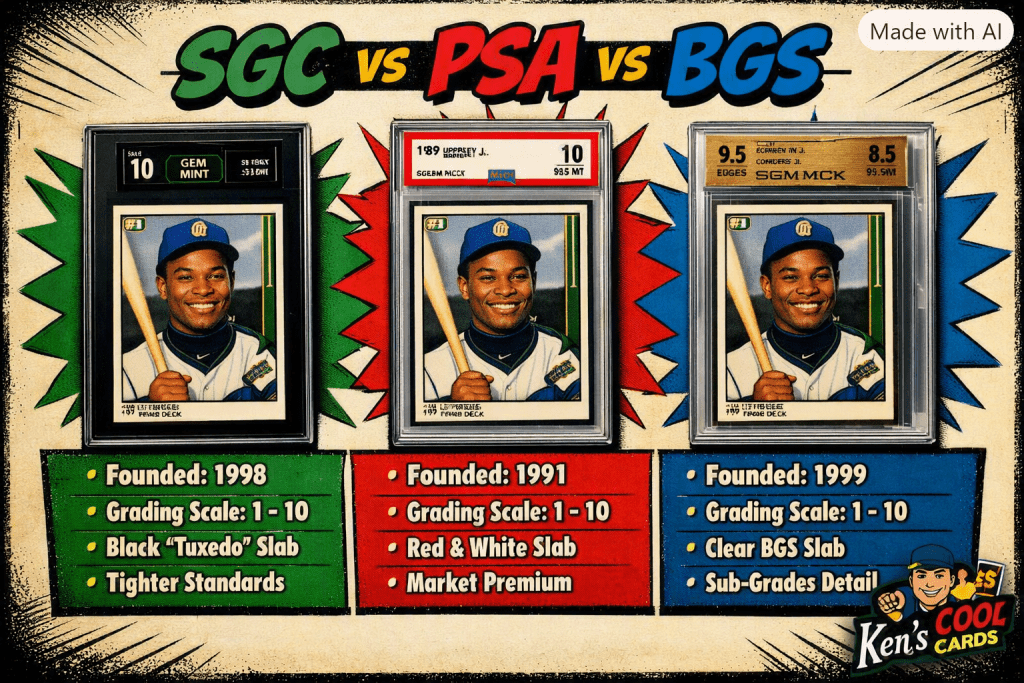
SGC vs. PSA vs. BGS: At-a-Glance Comparison
| Feature | SGC | PSA | BGS (Beckett) |
|---|---|---|---|
| Founded | 1998 (Boca Raton, FL) | 1991 (Santa Ana, CA) | 1999 (Dallas, TX) |
| Grading Scale | 1–10 with half grades (single overall grade) | 1–10 (whole grades only; select half grades) | 1–10 with sub-grades (centering, corners, edges, surface) |
| Slab Design | Black “Tuxedo” slab; gold label for Pristine 10 | Clear slab, white label, red PSA logo | Clear slab, blue label; Black Label for 10/10 composites |
| Vintage Strength | Excellent — Industry-leading for pre-1980s | Strong — Widest vintage population | Moderate — Less dominant in vintage |
| Modern Strength | Growing — Strong but below PSA liquidity | Excellent — Highest market premium on modern rookies | Strong — Sub-grades preferred by some modern collectors |
| Sub-Grades | No | No (for most services) | Yes (included free) |
| Annual Membership | Not required | $99/year (includes $50 voucher) | Not required |
| Economy Turnaround | ~75–180 business days (varies by tier) | ~100+ business days (Economy) | ~50+ business days (Economy) |
| Fastest Tier | Turbo: 2–3 business days at $150 | Super Express: 5 business days at $300 | Walk-Through: Same day at $250 |
| Economy Cost | $15–$50/card (varies; verify at gosgc.com) | $79.99/card (Economy, membership required) | Varies; ~$30/card (Standard) |
Pricing Note: Grading service pricing changes frequently. The figures above reflect research conducted in late 2026. Always verify current rates directly at gosgc.com before submitting.
3. The SGC Grading Scale Explained
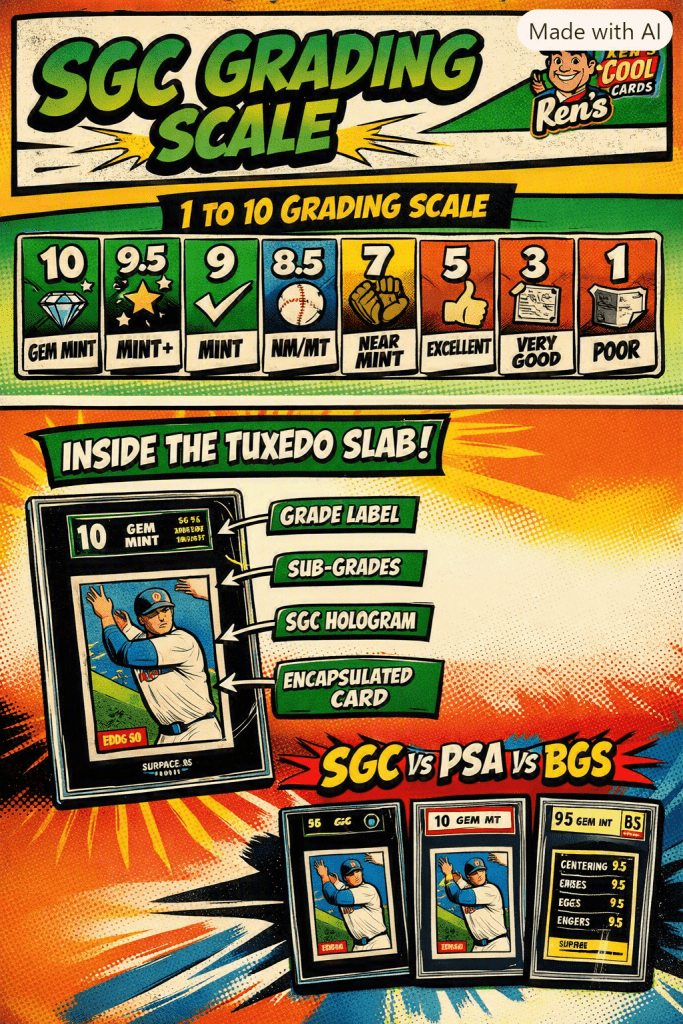
SGC uses a 1–10 numerical scale with half grades, resulting in a nuanced system that can reflect even fine differences in card condition. The overall grade is a single number — no sub-grades — making SGC slabs clean and immediately readable. Here is every grade on the scale.
SGC graders evaluate four primary attributes in every submission: Centering, Corners, Edges, and Surface. The final grade represents an overall composite assessment of all four factors. No single attribute alone determines the grade, but a severe deficiency in any one area will pull the overall grade down significantly.
| Grade | Label Name | Description & Visual Characteristics | Typical Collector Use |
|---|---|---|---|
| SGC 10 Pristine | Pristine (Gold Label) | The absolute pinnacle. Near-perfect on every single attribute. Flawless centering, four laser-sharp corners, perfectly clean edges, and brilliant original gloss. Essentially impossible to find a flaw even under magnification. The label prints in gold — the most prestigious slab SGC issues. | Ultra-premium investment grade; commands massive market premium over SGC 10 Gem Mint |
| SGC 10 Gem Mint | Gem Mint | The standard numeric 10. A pristine-looking card with no visible flaws at arm’s length. Four sharp corners, excellent centering, clean edges, original gloss fully intact. Minor imperfections may be visible only under magnification. Widely regarded as comparable to a PSA 10. | Top investment grade; highest demand for key rookies and vintage stars |
| SGC 9.5 | Mint+ | A high-end Mint card with a single minor flaw — typically a touch of centering drift or a tiny edge nick visible only under close inspection. Sits between SGC 9 and SGC 10 and is often a strong result for borderline vintage submissions. | Excellent investment card; preferred by many vintage collectors for its attainability vs. SGC 10 |
| SGC 9 | Mint | Strong corners with only microscopic flaws, excellent surface, minimal wear. Minor flaws on one or two attributes visible under 10x magnification. A clean, strong card at first glance. A very desirable grade for both vintage and modern. | Strong collector grade; high demand across all eras and player types |
| SGC 8.5 | Near Mint/Mint+ | One slightly soft attribute (often centering or a light corner touch) brings the card just below a 9. Still a clean, attractive card that presents well in a slab. Centering typically within 65/35. | Solid collector grade; strong value for key vintage cards with limited SGC 9s |
| SGC 8 | Near Mint/Mint | Two or three minor flaws visible on close inspection — slight corner wear, centering drift, or minor surface scuff. Corners mostly sharp; surface generally intact. A well-preserved card that has seen minor handling. | Popular vintage grade; often the sweet spot for pre-1960s cards where 9s are extremely rare |
| SGC 7.5 | Near Mint+ | Between Near Mint and Near Mint/Mint. Light wear on corners or edges, mild surface wear, centering in the 70/30 range. Still a presentable card with obvious collector appeal. | Common for well-handled vintage; good display card for popular players |
| SGC 7 | Near Mint | Noticeable wear on corners or edges under inspection. Slight surface wear affecting gloss. Centering may drift to 70/30 or beyond. Card is still clean and structurally sound. Three or more attributes show minor issues. | Mid-grade vintage; still highly desirable for key players and tough sets |
| SGC 6 | Excellent/Mint | Rounded corners begin to show, light surface scuffs, mild-to-moderate centering issues. Card is clearly handled but structurally intact. No creases. Common and very desirable on pre-war cards where higher grades are essentially unobtainable. | Pre-war and early vintage standard; excellent entry-level grade for star cards |
| SGC 5 | Excellent | Multiple flaws including rounded corners, possible light surface creases at edges, moderate centering. The card has obviously been handled but retains its basic structural integrity and visual appeal. Still a “collectible” grade on vintage issues. | Budget entry for key vintage cards; lower-cost way to own legendary issues |
| SGC 4 | Very Good/Excellent | Obvious corner wear with some rounding, light creases possible, surface wear evident. Still displays nicely despite flaws. Card paper is sound — no tears or severe damage. | Affordable vintage collecting; displays well framed or in a collection binder |
| SGC 3 | Very Good | Significant wear on all corners, possible light crease, surface scratches or scuffs. The card is well-worn but all elements are fully visible. No missing pieces or tears. | Budget vintage; acceptable for key pre-war cards where any graded copy is rare |
| SGC 2 | Good | Heavy wear, creases, rounded corners, possible staining or surface damage. The card is identifiable and intact but shows obvious, extensive use. Paper loss may be beginning. | Filler grade; useful for completing sets on a tight budget or for display in historical contexts |
| SGC 1.5 | Fair | Severe wear throughout. Significant creases, heavy staining, corner damage, possible small tears. The card is intact but barely collectible by condition standards. All major visual elements still identifiable. | Extremely low-grade; collector interest primarily in extreme scarcity situations |
| SGC 1 | Poor | The lowest numeric grade. Heavy damage including multiple creases, tears, significant paper loss, severe staining, or writing. The card is still identifiable as authentic but condition is severely compromised in almost every way. | Last resort for extremely rare cards; any copy better than nothing for ultra-scarce issues |
| SGC A | Authentic | No numeric grade assigned. The card is confirmed genuine but has been altered, trimmed, or otherwise manipulated to artificially improve its apparent condition. Common alterations include trimming borders, cleaning, or pressing. The card cannot receive a numeric grade but is authenticated as real. | Authentic but altered; significant market value reduction; important for documentation |
Ken’s Quick Grade Guide:
For vintage (pre-1970): Anything SGC 7 or above is exceptional. SGC 8+ is truly elite for most vintage issues.
For modern cards (1980s–present): Target SGC 9.5 or SGC 10 for maximum value. An SGC 8 on a modern card signals meaningful condition issues that will affect resale.
4. What SGC Grades: Eligible Card Types
One of SGC’s strengths is its broad eligibility — the company accepts an impressive range of card types from virtually every era and sport.
Sports Cards
- Baseball — From 1800s tobacco cards through current-year releases
- Football — Including vintage collegiate issues
- Basketball — Strong modern and vintage representation
- Hockey — Including early O-Pee-Chee and Parkhurst vintage sets
- Soccer / Football (International) — Growing segment with worldwide collector interest
- Other Sports — Boxing, golf, tennis, wrestling, MMA, and more
Non-Sport Cards
- Entertainment Cards — Movie, TV, and celebrity cards
- Gaming Cards — Pokémon, Magic: The Gathering, and other TCG cards are accepted
- Historical / Tobacco Issues — T206, T205, and other early non-sport tobacco card sets
Vintage vs. Modern Cards
SGC accepts cards from virtually every production era. This includes handmade 19th-century tobacco issues, early 20th-century gum cards, the golden age of Topps and Bowman in the 1950s–1970s, the junk wax era of the 1980s–1990s, and current-year releases. SGC’s vintage expertise is particularly renowned — auction houses and dealers worldwide specifically seek SGC-graded pre-war and early post-war cards.
Special Card Types
- Rookie Cards (RCs): One of the most popular submission categories — a graded rookie card of a star player can command multiples of its raw value.
- Autographed Cards: SGC authenticates and grades signed cards. The autograph is verified and the card receives an overall grade.
- Relic / Patch Cards: Cards featuring embedded fabric swatches or jersey patches — standard-sized relics are accepted.
- Refractors & Prizm Parallels: Chrome-technology cards including Bowman Chrome, Topps Prizm, and similar refractor technology are accepted.
- Short Prints & Variations: SGC identifies and notes documented short print variations and photo variations on eligible submissions.
Cards SGC Will NOT Grade
- Oversized cards that do not fit standard slab dimensions
- Cards with known counterfeit indicators that cannot be authenticated
- Certain thick booklet cards or multi-panel items exceeding slab capacity
- Cards with peeling laminates or severe structural damage beyond grading parameters
Pro Tip: When in doubt about whether your card is eligible, check SGC’s official eligibility guidelines at gosgc.com before spending money on packaging and shipping. A quick check saves you the headache of a returned submission.
5. How to Submit Cards to SGC: Step-by-Step
Submitting to SGC is straightforward once you know the process. Follow these steps carefully — the preparation stage is where most preventable mistakes happen. Check out our stand-alone guide and our first experience for submitting to SGC here!
Step 1 – Create Your SGC Account
Visit gosgc.com and create a free collector account. You’ll need a valid email address and a billing/shipping address. Account creation takes about two minutes and is required before you can place any submission.
Ken’s Tip: Use a permanent email address you check regularly — SGC sends important status updates and shipping notifications to this address. Don’t use a throwaway email for your submission account.
Step 2 – Choose Your Service Tier
Review the available service tiers (see Section 6 for full details). Choose based on two factors: your card’s declared value and how quickly you need it back. Remember — declared value must accurately reflect the card’s fair market value in raw (ungraded) condition.
Ken’s Tip: Don’t understate declared values to save on fees — this can void your shipping insurance and potentially violate SGC’s terms. It’s not worth the risk on valuable cards.
Step 3 – Fill Out the Online Submission Form
In your SGC account portal, complete the digital submission form for each card. You’ll need to provide: Year, Brand/Manufacturer, Player Name, Set Name, Card Number, and any known Variation or Parallel type. Be as specific as possible — accurate card information ensures correct labeling on your slab.
Ken’s Tip: Cross-reference your card details against TCDB (Trading Card Database) or Beckett’s online database before completing the form. Incorrect card details are one of the most common — and easily preventable — submission errors.
Step 4 – Prepare Your Cards for Shipping
Proper card preparation is critical. Each card should be protected as follows:
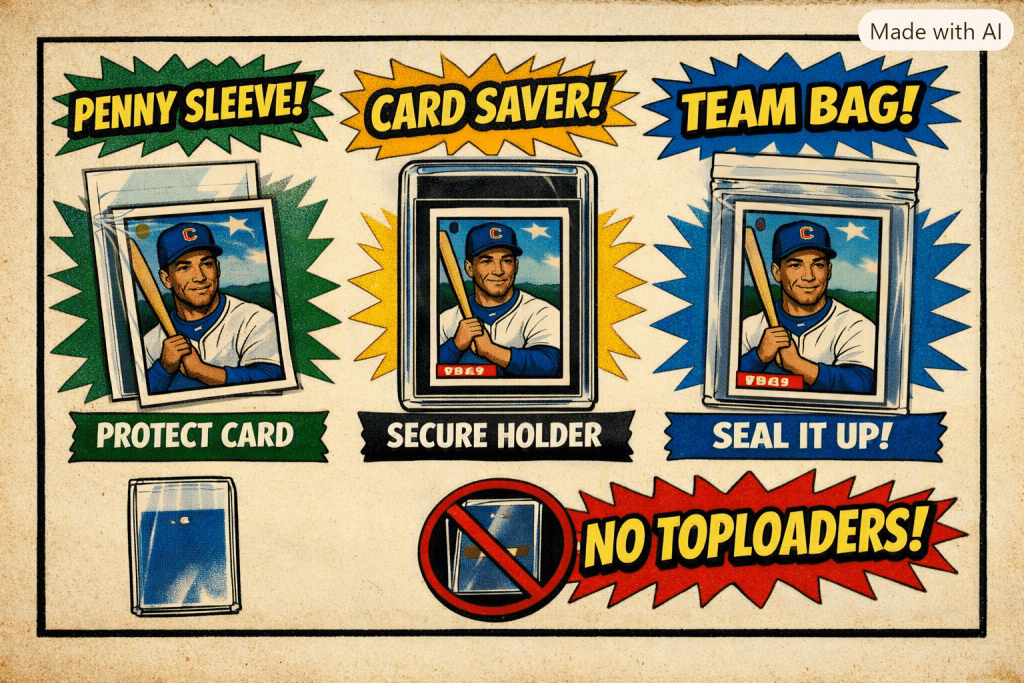
- Place each card in a penny sleeve (soft poly sleeve) first
- Insert the penny-sleeved card into a semi-rigid card holder (NOT a rigid top loader without an inner sleeve)
- You may also use team bags over penny-sleeved cards as an alternative to semi-rigids
- Cards should be free of dust, debris, and fingerprints — handle by edges only
- Organize cards in the same order as your submission form
Important Warning: Do NOT submit cards in rigid top loaders without a penny sleeve inside — the card can slide and sustain edge or corner damage in transit. Never use rubber bands directly around cards. These are among the most common packaging errors SGC sees.
Step 5 – Package Securely for Shipping
Once your cards are prepped:
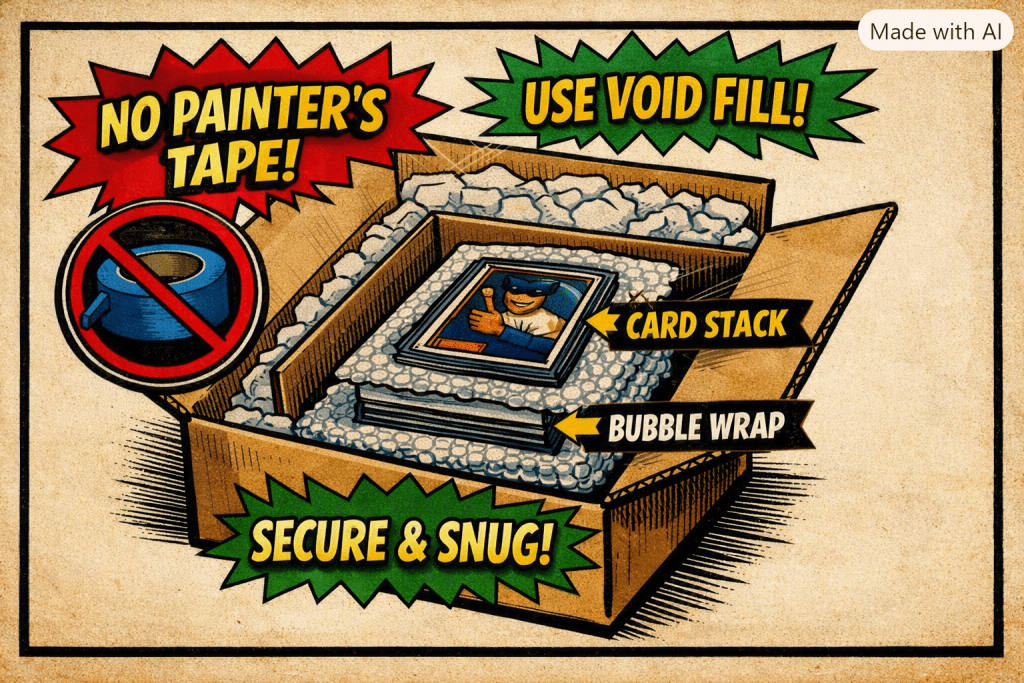
- Stack cards in submission order and secure lightly with a rubber band around the stack of holders (not the cards themselves)
- Place the stack in a small sturdy inner box with padding on all sides — bubble wrap or foam works well
- Place the inner box inside a larger outer shipping box with additional void fill (bubble wrap or packing paper)
- The package should have zero internal movement when shaken — if you can hear or feel cards shifting, add more padding
- Include your printed submission form inside the package
Ken’s Tip: Skip bubble mailers for anything valuable. A small rigid box inside a larger shipping box is far superior protection. I’ve seen cards arrive at graders with corner damage from flimsy bubble mailer packaging — don’t let that be your submission.
Step 6 – Ship to SGC Headquarters
Use the shipping address provided in your SGC submission confirmation email — do not use an address from an old submission or a third-party website. Use a reputable carrier (FedEx, UPS, or USPS) and always:
- Add tracking to your shipment
- Add insurance matching the declared value of your cards
- Keep your tracking number and receipt until you receive your slabs back
Step 7 – Track Your Submission
Once SGC receives and logs your package, your submission will appear in your account dashboard. Note: SGC’s turnaround clock starts after your order is unboxed and logged into their system — not the day it is delivered. Monitor your submission status regularly through the SGC portal.
Ken’s Tip: Be patient! Grading takes time, and contacting SGC about a submission that hasn’t cleared the turnaround window yet won’t speed things up. Check the portal and trust the process.
Step 8 – Receive Your Graded Cards & Inspect
When your slabs arrive, carefully open the return package and inspect each slab. Verify: card label accuracy (player name, year, set, grade), slab integrity (no cracks or damage), and card centering through the slab. If you notice a label error, contact SGC through the portal to initiate a correction. Welcome to the slab life — enjoy your graded cards!
6. SGC Service Tiers & Pricing (as of Sept 21 2026)
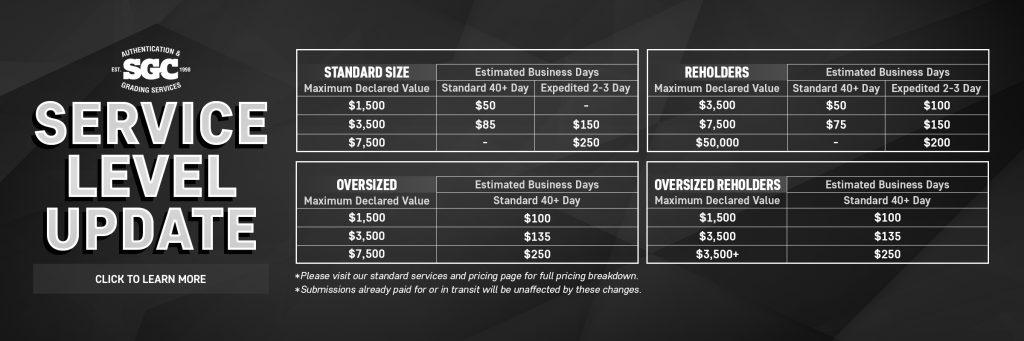
SGC recently implemented a major pricing overhaul that significantly impacts collectors and bulk submitters. The company raised its base grading fee from the long‑standing $15 tier to a new $50 Standard tier, marking one of the largest jumps in its history. The change eliminates budget submissions entirely and shifts all cards under $1,500 declared value into the $50 bracket with a roughly 40‑day turnaround. SGC stated the increase was necessary to manage overwhelming demand and stabilize turnaround times, with additional adjustments expected as the grading market continues to evolve.
7. Reading Your SGC Slab
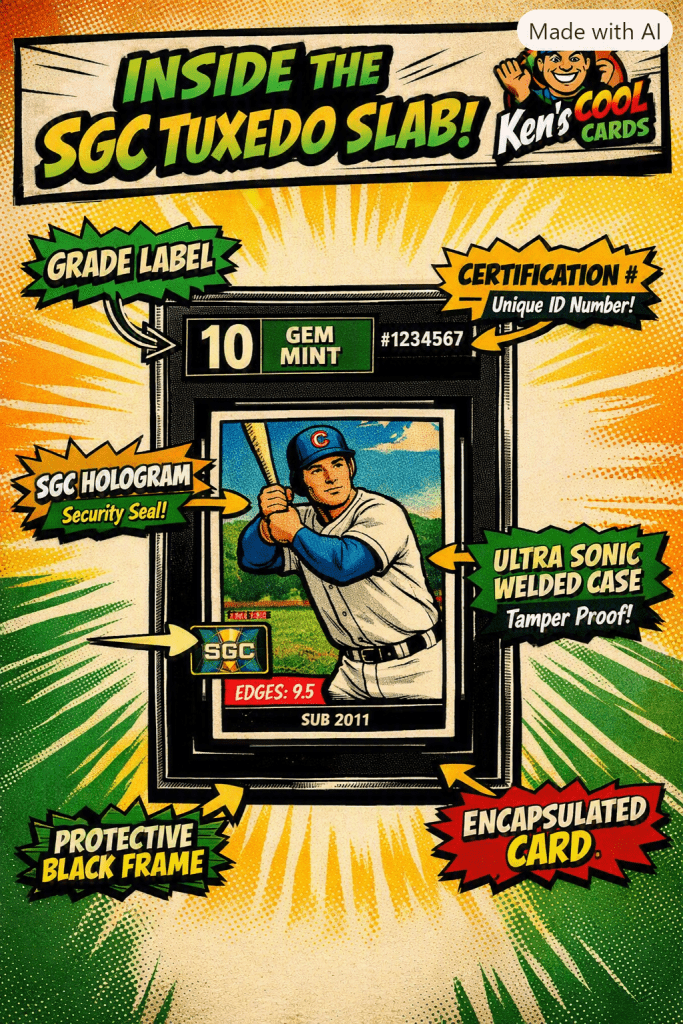
Your SGC slab is more than just a plastic holder — it’s a certified document of authenticity and condition. Here’s everything you’ll find on an SGC slab and what it means.
Anatomy of an SGC Slab
| Slab Element | Location | What It Means |
|---|---|---|
| SGC Logo | Top label area | Identifies the grading company. The iconic SGC wordmark is printed on the label inside the black-bordered Tuxedo case. |
| Hologram Authentication Sticker | Label area | A gold holographic security sticker that is tamper-evident. If the slab has been cracked open and re-sealed, the hologram will show evidence of tampering. This is your first line of physical authentication. |
| Player Name | Label — primary text | The full player name as identified during grading. For non-sport cards, this may be a character name, product name, or set identifier. |
| Card Year | Label | The production year of the card as verified during grading. |
| Card Manufacturer & Set Name | Label | The brand (e.g., Topps, Bowman, Upper Deck) and specific set name (e.g., “1986 Topps Traded”). Variation or parallel type may also appear here. |
| Grade Number | Label — large, prominent | The official SGC grade from 1–10 (with half grades). This is the most important single piece of information on the slab. The SGC 10 Pristine label prints in gold; all other grades print in the standard label format. |
| SGC Certification Number | Label — bottom | A unique alphanumeric certification number assigned to every card SGC grades. This number can be entered at gosgc.com/verify to confirm authenticity, view the original grade, and see the card’s details in SGC’s official registry. |
| The Tuxedo Frame | The holder itself | SGC’s distinctive black-bordered clear acrylic case. Unlike PSA’s all-clear white slab, SGC’s black border frames the card visually and is widely considered one of the most attractive slab designs in the hobby. The case shows both sides of the card. |
Label Colors and Their Meaning
- Standard Label (white/black text): Assigned to all numeric grades from SGC 1 through SGC 10 Gem Mint.
- Gold Label: Reserved exclusively for SGC 10 Pristine — the highest, most demanding grade SGC awards. When you see a gold label SGC slab, you know it has cleared the highest bar in SGC’s grading program.
How to Verify an SGC Slab Online
- Locate the SGC certification number on the slab label.
- Visit gosgc.com and navigate to the certification lookup or registry.
- Enter the certification number to view the card’s official SGC registry record.
- Confirm the player name, year, set, and grade match what is displayed on the physical slab.
- Any discrepancy between the physical slab and the registry record is a red flag — do not purchase the card until the discrepancy is resolved.
Ken’s Authentication Rule: Always verify the cert number before purchasing any SGC slab. Counterfeit slabs do exist in the market — they’re rare but not unknown. A 30-second lookup at gosgc.com confirms authenticity and protects you from expensive fraud. Make this a habit on every significant purchase.
8. SGC vs. PSA vs. BGS: Which Should You Choose?
This is the question every collector eventually asks, and the honest answer is: it depends. Here’s our detailed breakdown of when each service makes the most sense.
Choose SGC If…
- You collect vintage cards (pre-1980s) — SGC’s vintage reputation and expertise are unmatched. Top auction houses specifically seek SGC-graded vintage.
- You prefer tighter, more consistent grading standards — SGC’s grades are respected for their integrity. An SGC 9 often represents a stricter standard than a PSA 9 on the same card.
- You want the Tuxedo slab aesthetic — it’s genuinely one of the most beautiful slabs in the hobby, and it photographs beautifully for Whatnot shows and social media.
- You want faster turnaround at competitive prices — SGC’s Turbo tier at $150 for 2–3 days beats PSA’s $300 Super Express on the same timeline.
- You don’t want to pay an annual membership fee — SGC’s pay-per-card model is great for occasional or medium-volume submitters.
- You’re submitting bulk vintage lots — SGC’s bulk and economy tiers are well-suited to volume vintage submissions.
Choose PSA If…
- You want maximum marketplace liquidity — PSA slabs command the highest resale premiums on modern star rookies and key vintage across virtually every platform.
- You want the largest population reports — PSA’s pop reports are the most comprehensive in the hobby, giving you the best market data.
- You collect mainstream modern sports rookies (Prizm, Bowman Chrome, Topps Chrome) — PSA 10s on key rookies are the gold standard for maximum resale value.
- You value broadest collector recognition — PSA is the most recognized grading brand globally, which helps when selling to casual buyers or in international markets.
Choose BGS (Beckett) If…
- You collect modern cards and want sub-grades — BGS’s four sub-grades (centering, corners, edges, surface) provide unparalleled condition transparency.
- You want the prestigious Black Label (BGS 10) — a card that scores 10 on all four sub-grades is the most demanding single-card grade in the hobby and commands extraordinary premiums.
- You value Beckett brand recognition — especially for post-2000 cards where BGS has strong market presence.
“We love SGC for vintage and PSA for ultra-modern rookies. Always factor in the card’s intended destination — are you keeping it for your personal collection, or planning to sell? That single question should drive your grading company choice.”
— Ken, Ken’s Cool Cards, Evans, GA
Ken’s Personal Take: For my personal collection here at Ken’s Cool Cards, SGC is the first call on anything pre-1970. The Tuxedo slab looks incredible on vintage cards, and SGC’s vintage expertise means the grade actually means something. For modern key rookies I’m planning to flip on Whatnot? PSA 10 gets you the most money, period. And BGS is my recommendation for anyone who wants maximum condition transparency on modern inserts and parallels. Know your card, know your goal, choose accordingly.
9. Tips for Maximizing Your SGC Grade
You can’t change what condition a card is in — but you can absolutely make sure you’re giving every card its best possible chance before it arrives at SGC’s facility. Here are the key tips from Ken’s Cool Cards.
Handling & Storage
- Handle cards by the edges only. Fingerprints leave oils on the card surface that are visible under grading magnification and can permanently affect a grade. Never touch the front or back face of a card with bare fingers.
- Use penny sleeves immediately. The moment you acquire a card you intend to grade, put it in a penny sleeve. Don’t leave it exposed on a desk or in a box. Cards can accumulate scratches, dust, and surface damage incredibly fast.
- Store properly. Use penny-sleeved cards in semi-rigid holders stored vertically in a card storage box in a cool, dry, dark environment. Humidity, UV light, and temperature fluctuations are enemies of card condition.
Pre-Submission Evaluation
- Check centering before submitting. Use a centering tool, ruler, or a centering app on your phone to measure border widths on all four sides. Most grading apps can estimate a likely grade based on centering measurements. SGC’s standards require roughly 55/45 for a 10 and no worse than 70/30 for higher grades — know where your card falls.
- Inspect corners under magnification. Use a jeweler’s loupe or a magnifying glass to examine all four corners. Fuzzy, frayed, or rounded corners are the most common reason a card doesn’t achieve the grade a collector expects.
- Examine edges under raking light. Hold the card at an angle under a light source to reveal edge chips, nicks, or print lines that are invisible under direct lighting.
- Check the surface for scratches and print defects. Tilt the card under light to reveal surface scratches, print lines, or manufacturing defects that may affect the grade.
What NOT to Do
- Never use cleaning products on cards. No Windex, no water, no card cleaning sprays. The only accepted surface cleaning — if any — is a very light, dry microfiber cloth pass to remove loose dust, and even that carries risk. When in doubt, leave it alone.
- Never press cards. Attempting to flatten a bent card by pressing it is considered alteration and will result in an SGC A (Authentic) designation rather than a numeric grade.
- Never trim cards. Trimming borders to improve apparent centering is detectable by SGC’s graders and will result in an SGC A designation. It is also considered fraud in the hobby community.
Submission Strategy
- Know when NOT to grade. If a card is worth $15 raw and the best comparable SGC-graded version sells for $20, grading at $25 per card doesn’t make financial sense. Always run the break-even math first.
- Submit in bulk to reduce per-card shipping costs. The shipping cost of sending 20 cards is very similar to sending 5 cards. Bulk submissions dramatically improve your cost per card when factoring in inbound and return shipping.
- Research population reports before submitting. If a card’s SGC 10 population is already 500 copies deep, adding your card to the pile won’t command a premium — the market is saturated. Conversely, if the SGC 10 population is 3, your card has real scarcity value. Check pops at gosgc.com before committing to a submission.
- Consider SGC’s Crossover program. SGC offers a crossover service for cards already graded by other companies (PSA, BGS, etc.). If you have a card in a PSA slab that you believe may grade higher at SGC — or if you simply prefer the SGC aesthetic — the crossover program allows SGC to evaluate and re-slab the card with a new SGC grade.
Ken’s Golden Rule: The best time to protect a card is before it needs protecting. Every high-grade card you own today was at its best the moment it left the printing press. From that point on, every touch, every move, every moment of exposure is a chance for condition loss. The collectors who get the best grades are the ones who treat every card like it’s already a 10 — because it might be.
10. SGC Population Reports & Market Value
Understanding SGC’s population reports — “pop reports” — is one of the most powerful skills a serious collector can develop. It transforms your approach to buying, selling, and submitting cards.
What Is a Population Report?
A population report (universally called a “pop report” in the hobby) is a publicly accessible database maintained by grading companies that shows how many examples of a specific card have been graded at each grade level. For example, a pop report entry might show: 1952 Topps Mickey Mantle #311 — SGC 10: 2, SGC 9: 8, SGC 8: 14, SGC 7: 22 — telling you exactly how many copies of that card exist in each grade across all submissions to SGC.
How to Access SGC Pop Reports
- Visit gosgc.com and navigate to the Population Report section.
- Search by player name, set name, year, or card number.
- The report displays grade distribution across all copies SGC has graded.
- Use this data alongside eBay sold listings (in the same grade) for accurate market valuation.
How Low-Pop SGC 10s Command Premium Prices
Scarcity is the fundamental driver of premium pricing in graded cards. When an SGC 10 has a population of 1 or 2 copies, the market treats that card as a near-unique item. Collectors bidding on it know they are competing for one of the only copies that have cleared SGC’s highest standard — which drives prices far above what the grade alone would suggest.
Conversely, when an SGC 10 population climbs into the hundreds — common with modern, mass-produced cards — the market price for that grade stabilizes because supply is abundant. This is why vintage cards with naturally low populations tend to hold or grow in value, while modern parallel SGC 10s can see value erode as more copies are submitted and graded.
Case Study: The 1952 Topps Mickey Mantle (#311)
The 1952 Topps Mickey Mantle #311 is widely considered the holy grail of postwar baseball cards — one of the most iconic and valuable cards in the entire hobby. Let’s look at how SGC grade affects market value on a card of this magnitude:
| SGC Grade | Label | Approximate Market Range | Market Notes |
|---|---|---|---|
| SGC 10 Pristine | Gold Label | Multi-million dollar range | Essentially a one-of-a-kind market event when it appears at auction |
| SGC 9.5 | Mint+ | Hundreds of thousands to $1M+ | Extreme rarity; auction-only sales |
| SGC 9 | Mint | High six figures | Extremely rare; major investment grade |
| SGC 8 | Near Mint/Mint | Mid-to-high five figures | A legitimate vintage investment; strong demand |
| SGC 6 | Excellent/Mint | $15,000–$40,000+ | Most attainable high-grade version; strong collector demand |
| SGC 4 | Very Good/Excellent | $5,000–$15,000 | Entry-level graded Mantle; strong demand from collectors building sets |
| SGC 1–2 | Poor/Good | $1,000–$5,000 | Even “poor” copies of this card command meaningful premiums over many other cards entirely |
Note: The values above are illustrative estimates for context purposes only. Actual sale prices vary significantly based on specific population data, market conditions, and auction dynamics at time of sale. Always consult current eBay sold listings and major auction house results for accurate market data.
Using eBay Sold Listings + Pop Reports Together
- Look up the card’s SGC pop count at each grade level on gosgc.com.
- Search eBay for the specific card + SGC + grade, then filter by “Sold” listings.
- Look at the last 5–10 sales at that grade for a price range.
- Factor in pop: if the SGC 10 pop is 2 and the last sale was 18 months ago, the current value may be significantly higher than that last recorded sale.
- Also check PWCC, Goldin Auctions, and Heritage for high-end vintage comps.
11. Common SGC Grading Mistakes Collectors Make
Even experienced collectors make these mistakes. Learning from others’ errors saves money and heartbreak. Here are the most frequent submission pitfalls Ken’s Cool Cards has seen.
| Mistake | Why It Happens | How to Avoid It |
|---|---|---|
| Submitting cards with known defects hoping for a high grade | Optimism bias — “maybe the grader won’t notice.” They always notice. | Evaluate honestly before submitting. If you can see the issue, so can an SGC grader with better lighting and magnification. |
| Not checking centering before submission | Centering issues are easy to miss without measuring tools. | Measure border widths with a ruler or centering app on every card you plan to submit. Reject cards that fall outside the target range for your desired grade. |
| Improper packaging leading to shipping damage | Rushing the packaging process; using inadequate materials. | Follow packaging steps precisely. Use penny sleeve + semi-rigid holder. Use a rigid inner box, not just a bubble mailer. Test the package by shaking it — nothing should move. |
| Choosing the wrong service tier for card value | Trying to save money on a high-value card by selecting a cheaper tier. | Match your declared value to the appropriate tier. Undervaluing a card to save fees can leave you underinsured if the card is lost or damaged in transit. |
| Ignoring population data before submitting | Excitement about the card overrides strategic thinking. | Always check pop reports before submitting. High-pop grades don’t command premiums. Know the market before you spend on grading. |
| Submitting cards without verifying eligibility | Assuming all cards are eligible; not reading SGC’s guidelines. | Check gosgc.com’s eligibility guidelines. Oversized, non-standard, or heavily damaged cards may be returned ungraded — wasting your submission fee and return shipping cost. |
| Incorrect card information on the submission form | Not verifying year, set name, or card number before completing the form. | Cross-reference every card against TCDB, Beckett Online, or SGC’s own registry before submitting the form. Label errors require SGC corrections and delay your slabs. |
| Not adding tracking and insurance on inbound shipping | Trying to save a few dollars on the shipping label. | Always ship with full tracking and insurance equal to the total declared value of your submission. Cards can get lost — this is your only protection. |
The Biggest Mistake of All: The single most costly mistake collectors make is submitting a high-value card in inadequate packaging. A card worth $500 or more should be treated like the valuable it is during shipping. Don’t re-use old boxes, don’t skip padding, don’t use a thin bubble mailer. One damaged card from a preventable packaging failure will cost far more than the “savings” from skimping on packaging materials.
12. Final Thoughts from Ken’s Cool Cards
We’ve covered a lot of ground in this guide — and if you’ve made it this far, you’re already a more knowledgeable collector than you were when you started. Let’s wrap things up with some personal thoughts from Ken.
SGC Is a Trusted Partner for Serious Collectors
After years of collecting and working with graded cards here at Ken’s Cool Cards, I can tell you with confidence: SGC has earned its reputation. From the first graders who showed up in 1998 and were immediately overwhelmed with demand, to the modern operation they’ve built today, SGC has maintained a commitment to consistency and integrity that the hobby respects.
The red and gold label, the Tuxedo slab, the iconic SGC branding — these aren’t just aesthetic choices. They represent a standard. When you see an SGC slab on a table at a card show or on a Whatnot stream, you know what you’re getting. That consistency is invaluable in a hobby where condition claims are everything.
The Red Label Signals Quality and Authenticity
Whether it’s a T206 Honus Wagner in a vintage SGC holder or a 2023 Bowman Chrome rookie in a fresh Tuxedo slab, the SGC label is a statement. It says: “This card has been examined by professionals, its authenticity has been confirmed, and its condition has been independently verified.” In today’s hobby — where fakes, trimmed cards, and misrepresented conditions are real concerns — that statement is worth real money.
SGC Has a Place in Every Serious Collection
Whether you’re a vintage purist who obsesses over pre-war tobacco cards, or a modern collector chasing the latest chrome rookies, SGC has a place in your collection strategy. The no-membership model makes it accessible, the Tuxedo aesthetic makes it beautiful, and the grading reputation makes it trustworthy. What more could a collector ask for?
Connect With Ken’s Cool Cards
The hobby is always more fun when you’re part of a community. We’d love to connect with you! Find Ken’s Cool Cards across social media and join us live on Whatnot where we regularly feature SGC-graded cards, live breaks, and collector conversations. If you’ve got questions about grading, submissions, or anything card-related — drop us a message. We’re always happy to help a fellow collector.
- Website: KensCoolCards.com
- Whatnot: Search “Ken’s Cool Cards” — join our live streams!
- Social Media: Follow us for daily card content, pack breaks, and grading tips
Ready to Start Grading?
Check out our latest inventory of SGC-graded cards at Ken’s Cool Cards! We carefully curate our graded inventory with cards that have been submitted by knowledgeable collectors and authenticated by trusted grading services. Whether you’re looking for a vintage gem or a modern investment card in a Tuxedo slab, we’ve got something for you.
Visit KensCoolCards.com or catch us live on Whatnot — and happy collecting! 🃏
Sources & Verification
This guide was researched and written in September 2026. Pricing, turnaround times, and service tier information were cross-referenced against multiple published sources including gosgc.com, WaxEngine, and collector community resources. All pricing is subject to change — always verify current rates and policies directly at gosgc.com before placing a submission. SGC, PSA, and BGS are trademarks of their respective companies. Ken’s Cool Cards is an independent collector brand and is not affiliated with SGC, Collectors, or any grading company.
Card values referenced in this guide (including case study examples) are for illustrative and educational purposes only and do not constitute financial advice. Always consult current market data from reputable auction platforms and dealers for accurate card valuations.
© 2026 Ken’s Cool Cards | KensCoolCards.com | Evans, GA | All Rights Reserved
SGC Grading: The Complete Guide for Sports Card Collectors | Published September 2026 | For educational and informational purposes only
How to Grade Your Cards
Card Care & Storage Tips
PSA vs SGC vs BGS Comparison
SGC Cert Verification
SGC Population Report
Start an SGC Submission
PSA Official Website
BGS (Beckett) Grading